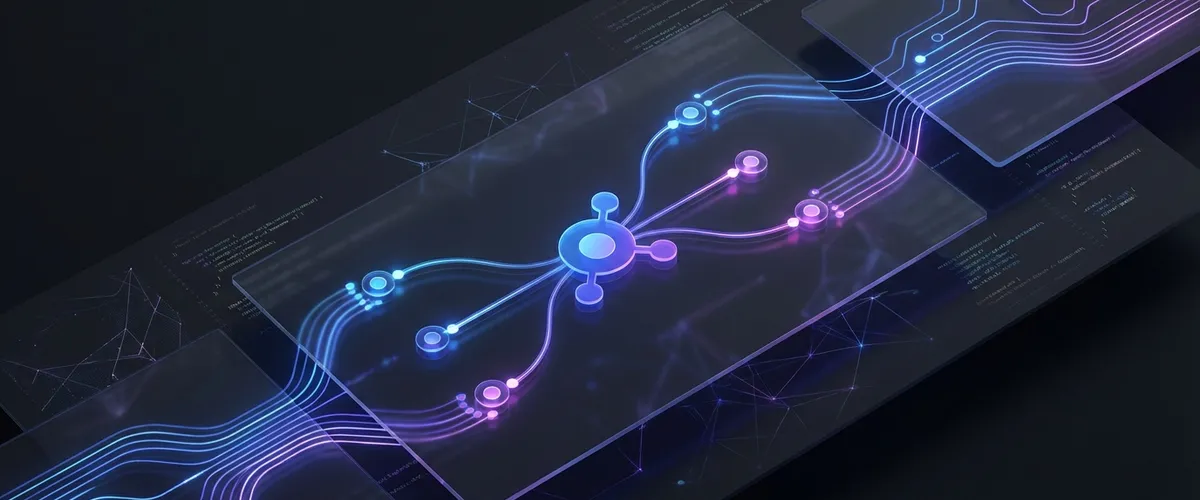
Context Engineering Through Layered Intelligence
- Jake Ruesink
- AI
- 07 Apr, 2026
We spent a couple of years obsessing over prompt engineering.
That made sense for the first wave of LLM tools. If the model only got one shot, the main lever you had was the prompt itself.
But that is not the bottleneck anymore.
In 2025 and 2026, the conversation shifted from what words should I type? to what information should this agent have, in what order, with what memory, tools, and boundaries? Anthropic captures that shift well in Effective Context Engineering for AI Agents, where they describe context engineering as the broader problem of curating the full token environment an agent operates inside. Gartner put it even more bluntly in July 2025: “context engineering is in, and prompt engineering is out.”
That framing matches what many of us are seeing in practice. When an agent does mediocre work, the problem usually is not that the prompt was a little off. The problem is that the agent had the wrong context, too much context, stale context, or no durable memory between turns.
That is why layered agent systems are becoming so compelling.
One concrete example is ClawConnect, an open-source MCP server and CLI for connecting AI coding agents like Claude Code, Cursor, Codex, ChatGPT, and Windsurf to OpenClaw instances. It exists because there is a gap between the local agent that understands your repo and the remote worker that can execute longer-running delegated work. ClawConnect gives those systems a clean way to talk.
In practice, that means your orchestrator can stay focused on gathering context, framing the task, and interpreting results, while your OpenClaw worker handles execution in a separate session with its own tools, memory, and artifacts. That split is the heart of this post. It is not just a neat integration. It is a practical example of context engineering through layered intelligence.
Instead of asking one model to do everything inside one giant conversation, you let one model manage the work and another model execute focused tasks. Think of it as an orchestrator and a worker. Or, using Anthropic’s term from Building Effective Agents, the orchestrator-workers pattern.
This post is about why that pattern works, and why I think it is one of the most practical forms of context engineering available right now.
Context engineering is the real work
Prompt engineering is a slice of context engineering, but only a slice.
A capable agent does not just need instructions. It needs an environment.
That environment includes:
- the system prompt and task framing
- relevant files and code excerpts
- recent diffs and git history
- tool availability
- memory from previous turns
- execution logs and artifacts
- constraints about what success looks like
In other words, the agent’s performance is shaped by the full information surface around it, not just the one paragraph you typed into a box.
That matters a lot in software work because software problems are rarely self-contained. A useful answer often depends on understanding repository structure, current branch state, prior attempts, naming conventions, architecture boundaries, and what changed recently. Humans are bad at compressing all of that into one prompt. Even when we try, we either omit important details or dump too much irrelevant material into the context window.
That is where layered intelligence starts to outperform direct prompting.
Why a manager LLM beats a direct prompt
If you ask an orchestrator like Claude Code, Cursor, or Codex to solve a problem, it can do much more than forward your sentence to another model.
It can gather context first.
It can inspect the repo, read the relevant files, look at recent commits, compare diffs, identify neighboring modules, and infer what kind of change is actually being requested. Then it can pass a much better-scoped task to a worker.
That is fundamentally different from a human trying to hand-author a perfect mega-prompt.
The manager model is better at this job for a few reasons:
- It can gather repo context automatically instead of relying on your memory.
- It can frame the task strategically before delegation.
- It can keep track of what has already been tried.
- It can interpret the worker’s output and decide what follow-up is needed.
- It can maintain continuity across multiple related tasks.
That last point matters more than people realize.
A good orchestrator is not just sending work out. It is curating a sequence. It is deciding what this worker needs right now, what can be deferred, and what should stay out of scope entirely.
That is context engineering.
The orchestrator-workers pattern
Anthropic calls this the orchestrator-workers workflow: a central LLM dynamically breaks down a problem, delegates subtasks to worker LLMs, and synthesizes the results.
That pattern is especially useful in coding because the shape of the work is rarely obvious up front. You may think a change touches one file, but it actually spans config, UI, tests, and a hidden utility module. Or the first attempt reveals that the real issue lives in a neighboring subsystem.
An orchestrator can adapt. It can decide:
- whether the task should be split at all
- what specific subtask a worker should receive
- which context belongs with that subtask
- when to continue the same session versus start a fresh one
- how to evaluate the returned work
Here is the simplest version of the pattern in practice:
Human
  -> Orchestrator agent (Claude Code, Cursor, Codex)
      -> gathers repo context, history, constraints
      -> delegates focused task via MCP
          -> Worker agent (OpenClaw)
              -> executes in a fresh, bounded context
              -> returns summary + artifacts
      -> interprets result, decides next step, reports back
That is not layering agents for the sake of it. It is separating context curation from task execution.
Context isolation solves context rot
One of the biggest practical failures in single-agent systems is context rot.
Long conversations feel powerful because they preserve everything. But preserving everything is not the same as preserving relevance.
As contexts get longer, models become less reliable at finding and weighting the right information. Anthropic explicitly calls out context rot in its context engineering post. Research from Chroma on long-context performance shows that model quality degrades as input length grows, even on relatively controlled tasks. The older Lost in the Middle result made the same point from another angle: important information becomes less reliably used when it is buried in the middle of a long context.
The exact drop varies by model and benchmark, but the pattern is consistent: bloated context is not free.
That is why delegation to a fresh worker context is often better than keeping one agent trapped inside a sprawling conversation.
A worker should not inherit every detour, every dead-end hypothesis, every earlier draft, and every unrelated file the orchestrator ever looked at. It should get a clean window with the minimum useful context for the task at hand.
That is how you reduce noise, sharpen execution, and avoid making the model search a junk drawer for the one thing that matters.
MCP is the connective tissue
To make this pattern practical, you need a standard way for an orchestrator to talk to workers.
That is where MCP matters.
Model Context Protocol has quickly become the connective tissue between AI applications and external tools. Anthropic introduced it, and support has since spread across the ecosystem, including OpenAI, Google, Microsoft, and most of the major AI coding environments.
The best part is that the interface can stay simple even when the implementation underneath is not.
In ClawConnect, the MCP server exposes just three tools:
run_taskcheck_tasklist_sessions
That is enough.
Those three tools hide a lot of complexity:
- async execution against a remote OpenClaw instance
- long-polling with 50-second blocks
- structured progress updates
- artifact extraction
- reconnecting to previous sessions
- continuing multi-turn conversations with
sessionKey
From the orchestrator’s point of view, though, it gets a clean contract: submit work, check status, continue where you left off.
That simplicity is exactly what you want from a protocol layer.
ClawConnect as a concrete example
ClawConnect is an open-source MCP server and CLI for connecting AI coding agents to OpenClaw instances.
What I like about it is that it demonstrates the layered pattern clearly without pretending to be the only way to build it.
The architecture is straightforward:
packages/coreowns the gateway connection, sessions, artifacts, and shared tool logicpackages/mcpexposes a stdio MCP server for tools like Claude Code, Cursor, and Codexpackages/cligives you the same flow from a shell-friendly CLIapps/chatgptprovides an HTTP MCP server plus a progress widget for ChatGPT
So the stack looks like this:
Claude Code / Cursor / Codex / ChatGPT
  -> ClawConnect MCP layer
      -> OpenClaw gateway
          -> OpenClaw worker agent
The orchestrator gathers local context from the codebase it is already working in. Then it delegates through MCP. The worker handles the execution in OpenClaw. Results come back with summaries and artifacts, and the orchestrator decides what to do next.
That split is the key.
ClawConnect is not trying to cram every concern into one model session. It lets the local coding agent stay good at repo exploration and task framing, while the remote worker stays good at focused execution and follow-through.
Session continuation is where the system gets smarter
The most useful part of this pattern is that the worker is not stateless.
Every task can return a sessionKey. If the orchestrator passes that key back on the next run_task, the worker continues the same conversation.
That means you get continuity without carrying the whole prior context in-band every time.
The orchestrator does not need to re-explain the entire situation on each follow-up. It can say, effectively:
- continue from the previous task
- fix the edge case we just found
- add tests for that change
- now open a PR
This is how compounding intelligence starts to show up in practice.
The worker accumulates task-local memory across turns. The orchestrator accumulates strategic memory about the broader objective. Neither side has to hold everything all at once, but together they can iterate coherently.
That is a much better operating model than forcing a single agent to carry every detail of every prior step in one ever-expanding thread.
Why this produces better work
The benefit of layered intelligence is not that more agents automatically means more intelligence.
The benefit is that each layer gets a better job description.
The orchestrator:
- gathers and curates context
- decomposes or scopes the task
- chooses when to delegate
- interprets outcomes
- recommends next steps
The worker:
- receives a focused problem
- works in a cleaner context window
- executes without unrelated noise
- returns concrete artifacts and progress
That division improves quality because it aligns the model’s context with its current responsibility.
Single-agent flows tend to blur these responsibilities together. The same model is asked to remember the whole conversation, reason about the architecture, decide what matters, execute the task, track status, and explain results. Sometimes that works. On simple tasks, it is often enough.
But on messy, real-world engineering problems, separation helps.
Not because the worker is magically smarter. Because the system is better designed.
The practical takeaway
The constraint to pay attention to in AI-assisted development is not raw model intelligence. It is context design.
If you want better outcomes, spend less time polishing heroic prompts and more time designing:
- what context gets gathered
- what context gets excluded
- when a fresh context should be created
- how continuity should persist across turns
- how tools should expose async work simply
That is the real shift from prompt engineering to context engineering.
ClawConnect is one open-source example of what that looks like in the wild: an orchestrator-worker system connected by MCP, using minimal tools to hide a lot of execution complexity, and using session continuation to make delegation actually useful over time.
I do not think this is the only pattern that matters. But I do think it is one of the clearest ones.
The future probably belongs to systems that are good at layering intelligence, not just generating text.
And that starts with giving each agent the right context, at the right time, for the right job.
Getting started with ClawConnect
If you want to try this pattern yourself, the quickest path is to clone ClawConnect, install dependencies, and run the workspace build so the MCP server and CLI are ready. From there, you point it at an OpenClaw instance with your OPENCLAW_URL, OPENCLAW_PASSWORD, and optional OPENCLAW_AGENT_ID, then add the MCP server to your coding tool of choice.
ClawConnect supports stdio MCP for tools like Claude Code, Cursor, Codex, and Windsurf, plus an HTTP MCP app for ChatGPT. The repo includes setup examples, available tools, and session continuation details. If this workflow sounds useful, start here: github.com/lambda-curry/clawconnect.